Skip to product information
1 of 1

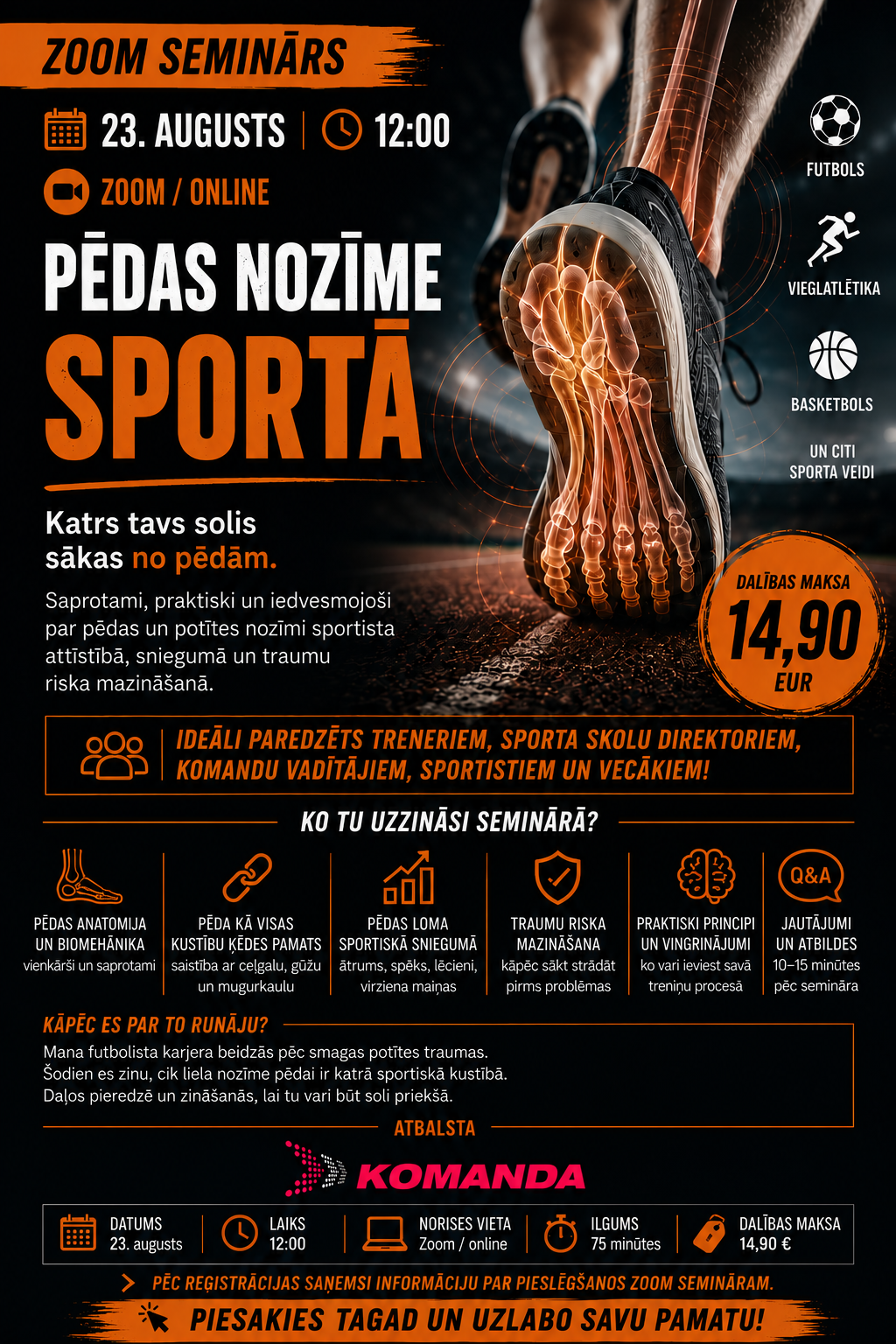
ZOOM WEBINAR — FOOT AND ANKLE IN SPORTS

August 23 | 12:00 PM | Online | 75 minutes

Every step you take starts from your feet.

We train speed, strength, endurance, coordination, and technique. However, we very often forget about the place where almost every athletic movement begins — the foot and ankle.

Sprint. Jump. Landing. Braking. Change of direction. Balance.

It all starts the moment the foot makes contact with the ground.

The foot is not simply a body part inside a sports shoe. It is a complex structure that must be able to adapt to loads, provide stability, control movement, and help transfer force further along the entire body's movement chain.

That's why I have created this 75-minute Zoom webinar, where we will discuss the importance of the foot and ankle in an athlete's development in an understandable and practical way.

The seminar is intended not only for individual athletes and coaches. It will also be valuable for sports school directors, sports organization and team managers who make decisions about the preparation of young athletes and want to improve the training process in their organization.

Prior knowledge of anatomy or biomechanics is not required. My goal is to explain complex things simply — so that the knowledge gained after the seminar can be applied in practice.

WHAT WILL YOU LEARN?

1. Foot anatomy — simply about the complex

We will examine the structure of the foot and ankle and their most important components.

Not to memorize anatomical terms, but to understand how the foot works in motion and why foot musculature, toes, and ankle movement control are important for an athlete.

2. The foot as the foundation of the kinetic chain

What happens further in the body the moment the foot makes contact with the ground?

We will talk about the connection of the foot and ankle with the knee, hip, and the rest of the body, as well as about absorbing and transferring force during movement.

The goal is to start looking at the body not as separate parts, but as a unified movement system.

3. The importance of the foot in athletic performance

We will examine the role of the foot and ankle in:

• acceleration and sprinting;
• transferring force to the ground;
• jumping and landing;
• braking and changes of direction;
• balance and stability;
• movement control.

4. Why do we so often ignore our feet?

We train the whole body, but we often only start thinking about our feet and ankles when something already hurts or an injury has occurred.

We will talk about the most common mistakes in athlete preparation and how to integrate foot and ankle training into the overall athlete development process.

5. Reducing injury risk and long-term athlete development

We will look at how foot and ankle strength, mobility, stability, and movement control can become part of thoughtful athlete physical preparation and injury risk reduction.

Specifically, we will discuss why it is worth starting to work with your feet and ankles before problems arise.

6. How to apply this knowledge in practice?

This is a Zoom webinar, but it will not be just a theoretical lecture.

I will show and explain practical exercise examples and principles that coaches can integrate into the training process and athletes can use in their daily work.

7. Questions and Answers

At the end of the seminar, time is allocated for a Q&A session, where you can ask your questions about foot and ankle training, athlete preparation, and topics covered in the seminar.

WHO IS THE SEMINAR FOR?

The seminar will be especially valuable for:


🏫 Sports school directors and sports organization managers
Sports team managers and coaches
🏃 Athletes and young athletes
💪 Strength and conditioning coaches
🦵 Physiotherapists and rehabilitation specialists
👨‍👩‍👧 Parents of young athletes
👟 Anyone who wants to better understand the importance of the foot and ankle in movement

WHY AM I TALKING ABOUT THIS?

My professional football career ended much earlier than I had planned — after a severe ankle injury.

Later, as a coach working with young footballers for years, I became much more deeply interested in the role of the foot and ankle in an athlete's movement and long-term development.

Today I often think:

“If only I had known some of what I know now at the beginning of my football career.”

That's why I want to pass this knowledge on — to athletes, coaches, parents, and people who create athlete preparation systems.

SEMINAR INFORMATION

📅 Date: August 23
🕛 Time: 12:00 PM
💻 Location: Zoom / online
⏱️ Duration: 75 minutes
💶 Participation fee: €14.90

After registration, you will receive information on how to join the Zoom seminar.

A STRONG BODY STARTS FROM THE FOUNDATIONS.

If you are a coach, athlete, parent, sports school director, or team manager and want to better understand why the feet and ankles are so important in an athlete's development and what to do with this knowledge in practice, join us on August 23.

APPLY FOR THE ZOOM WEBINAR — €14.90

Every seminar recording will be available 24h after the online seminar!


RaivisHscanovics.com

View full details
Contact form

What the professionals say

Raivis Hščanovičs

Raivis Hščanovičs

Former professional soccer player with MLS experience

"Ankle injuries were the biggest challenge I faced during my youth football career. Unfortunately, I don't remember any coach who paid increased attention to them: the importance of the foot and ankle, running technique, and specialized exercises to strengthen them. I had to end my professional football career at the age of 26 precisely after a broken foot."
Jānis Ikaunieks

Jānis Ikaunieks

Latvian National Football team and RFS player

"All shots, passes, and ball control start from the foot. Your ankle is your main support on the field. When it's strong, you have much better stability, faster and more confident changes of direction, a more powerful push-off, and more precise ball control. Most importantly, a strong ankle significantly reduces the risk of injury and allows you to play without fear of giving your all in every play."
Aleksandrs Cauņa

Aleksandrs Cauņa

Former Latvian national team and Moscow CSKA player

"Speaking about my experience, weight control and nutrition would always come first. Even a small weight gain (just 500g) can significantly increase the load on the feet and ankles, which rapidly increases the risk of injury. Secondly, I would definitely mention a thorough diagnosis and a patient recovery process. You should never rush back to the field too quickly – it almost always leads to recurring problems. These recurring foot and ankle injuries were one of the main reasons why I was unable to fully realise my potential on the football field. Therefore, I highly recommend all young footballers to pay attention to strengthening their ankles and feet to reduce the risk of potential injuries."
Mihails Koņevs

Mihails Koņevs

One of the most decorated Latvian football coaches

"In my youth, I sustained many injuries that led to chronic foot and ankle problems. At the time, I had the potential to become a good footballer; in Latvia, I was even considered one of the strongest midfielders in my age group. However, these chronic foot and ankle injuries prevented me from fully realizing my potential. Now, working as a coach, I see very clearly that strong and healthy feet and ankles are one of the main prerequisites for a young footballer to build a sustainable professional career. Without them, it is extremely difficult to reach a high level. Therefore, to all young footballers with serious ambitions, I strongly recommend paying increased attention to this aspect from an early age."
Kristaps Grebis

Kristaps Grebis

Liepāja football bomber

"Although I didn't have many foot and ankle injuries during my career, I understood very well the importance of a strong foot and ankle. Everything in football starts from the ground up. When your ankle is weak, you unconsciously save yourself when changing direction and landing. This takes away confidence and speed. If I had started intentionally training my foot and ankle earlier, I am sure I would have had more power and stability on the field. It really is the foundation of the entire game."
Guntars Silagailis

Guntars Silagailis

Head coach of "Rēzekne" / former professional footballer

"As a former professional football player and now a youth coach, I have seen the same scenario many times – young players train their thighs and calves a lot, but almost no one trains their feet and ankles. During my career, my ankle was never my biggest weakness, but the more I played, the clearer I understood – everything starts from the bottom. When your ankle and foot are strong, you have a completely different confidence when changing direction and landing. This gives you the freedom to play without fear and at full power. I am convinced that targeted foot and ankle training is one of the smartest things a young footballer can do for their development."
Raivis Hščanovičs

Raivis Hščanovičs

Former professional soccer player with MLS experience

"Ankle injuries were the biggest challenge I faced during my youth football career. Unfortunately, I don't remember any coach who paid increased attention to them: the importance of the foot and ankle, running technique, and specialized exercises to strengthen them. I had to end my professional football career at the age of 26 precisely after a broken foot."
Jānis Ikaunieks

Jānis Ikaunieks

Latvian National Football team and RFS player

"All shots, passes, and ball control start from the foot. Your ankle is your main support on the field. When it's strong, you have much better stability, faster and more confident changes of direction, a more powerful push-off, and more precise ball control. Most importantly, a strong ankle significantly reduces the risk of injury and allows you to play without fear of giving your all in every play."
Aleksandrs Cauņa

Aleksandrs Cauņa

Former Latvian national team and Moscow CSKA player

"Speaking about my experience, weight control and nutrition would always come first. Even a small weight gain (just 500g) can significantly increase the load on the feet and ankles, which rapidly increases the risk of injury. Secondly, I would definitely mention a thorough diagnosis and a patient recovery process. You should never rush back to the field too quickly – it almost always leads to recurring problems. These recurring foot and ankle injuries were one of the main reasons why I was unable to fully realise my potential on the football field. Therefore, I highly recommend all young footballers to pay attention to strengthening their ankles and feet to reduce the risk of potential injuries."
Mihails Koņevs

Mihails Koņevs

One of the most decorated Latvian football coaches

"In my youth, I sustained many injuries that led to chronic foot and ankle problems. At the time, I had the potential to become a good footballer; in Latvia, I was even considered one of the strongest midfielders in my age group. However, these chronic foot and ankle injuries prevented me from fully realizing my potential. Now, working as a coach, I see very clearly that strong and healthy feet and ankles are one of the main prerequisites for a young footballer to build a sustainable professional career. Without them, it is extremely difficult to reach a high level. Therefore, to all young footballers with serious ambitions, I strongly recommend paying increased attention to this aspect from an early age."
Kristaps Grebis

Kristaps Grebis

Liepāja football bomber

"Although I didn't have many foot and ankle injuries during my career, I understood very well the importance of a strong foot and ankle. Everything in football starts from the ground up. When your ankle is weak, you unconsciously save yourself when changing direction and landing. This takes away confidence and speed. If I had started intentionally training my foot and ankle earlier, I am sure I would have had more power and stability on the field. It really is the foundation of the entire game."
Guntars Silagailis

Guntars Silagailis

Head coach of "Rēzekne" / former professional footballer

"As a former professional football player and now a youth coach, I have seen the same scenario many times – young players train their thighs and calves a lot, but almost no one trains their feet and ankles. During my career, my ankle was never my biggest weakness, but the more I played, the clearer I understood – everything starts from the bottom. When your ankle and foot are strong, you have a completely different confidence when changing direction and landing. This gives you the freedom to play without fear and at full power. I am convinced that targeted foot and ankle training is one of the smartest things a young footballer can do for their development."